Wine Tasting Terms Explained in Plain English
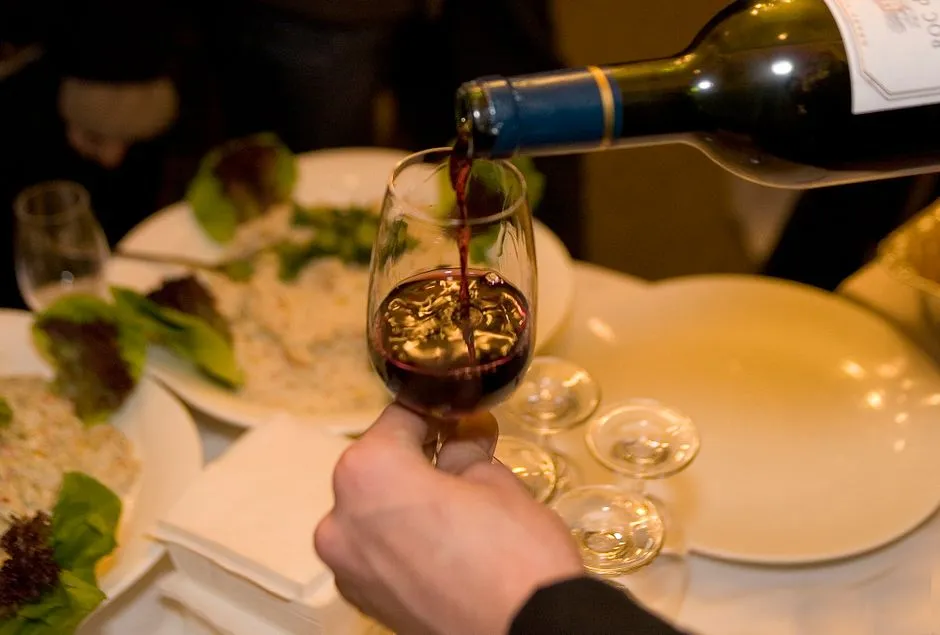
- What do wine tasting terms actually mean?
- Why does wine vocabulary sound so vague?
- What do aroma words like "cherry" or "petrol" describe?
- What do "dry," "crisp" and "flabby" tell you?
- What do "tannic," "grippy" and "silky" mean?
- What do "body," "full-bodied" and "hot" refer to?
- What does "balanced" mean in a wine?
- What is the finish, and how long is "long"?
- Which tasting words are only shorthand?
- Which terms describe a wine fault?
- A plain-English translation table
- Sources
What do wine tasting terms actually mean?
Most wine tasting terms describe one of four things you can check yourself: what the wine smells like (aroma), how it feels in your mouth (structure and texture), whether those parts fit together (balance), and how long the pleasant flavor lasts after the wine is gone (finish). To translate any description, turn each word back into a question you can answer from the glass. Some popular words, such as "minerality" or "great legs," are shorthand with no agreed meaning.
For the step-by-step method of tasting and writing notes, see our guide on how to taste wine; this article is the dictionary that sits beside it.
Why does wine vocabulary sound so vague?
Smell is hard to put into words, and the vocabulary was built for professionals who share a training. Even there, the words are a prompt rather than a code. The tasting lexicon of the Wine & Spirit Education Trust (WSET), a wine-education body, tells students it is "a prompt and a guide which you do not need to memorise," and that examiners will accept other descriptors "so long as they are accurate" (WSET Level 3 Systematic Approach to Tasting Wine and Wine-Lexicon). The standard, in other words, is not "use the right word" but "say something true."
What do aroma words like "cherry" or "petrol" describe?
Aroma words are resemblances, not ingredients. Nobody added cherries or petrol to the bottle; the wine contains compounds that remind tasters of those things. The WSET lexicon groups aromas by where they come from, which is the most helpful way to decode a description:
- Primary aromas are "the aromas and flavours of the grape and alcoholic fermentation." This is where the fruit words live (apple, lemon, peach, raspberry, blackcurrant), plus floral words and green ones such as bell pepper, grass and mint.
- Secondary aromas are "the aromas and flavours of post-fermentation winemaking." Bread, biscuit and brioche point to yeast; butter and cream point to malolactic conversion (a second, bacterial fermentation that softens a wine's acidity); vanilla, cloves, toast, cedar and smoke point to oak.
- Tertiary aromas are "the aromas and flavours of maturation." For aged whites the lexicon lists words such as petrol, honey and hay; for aged reds, leather, forest floor, earth, mushroom and tobacco.
Read through that filter, "vanilla and toast" suggests oak, "forest floor and leather" suggests bottle age, and "jammy," which the lexicon files under dried and cooked fruit, suggests ripe, concentrated fruit rather than fresh.
What do "dry," "crisp" and "flabby" tell you?
Dry refers to sweetness only: a dry wine does not taste sweet. It does not mean the wine dries out your mouth (that is tannin, below), and a wine with ripe fruit aromas can smell sweet and still taste dry. Alcohol can add to the illusion; WSET notes that alcohol "can enhance the perception of sweetness" (WSET: What is mouthfeel?). WSET's tasting scale for sweetness runs dry, off-dry, medium-dry, medium-sweet, sweet and luscious.
Crisp, zesty and flabby are acidity words. WSET's diploma-level tasting guide gives the observable test: "The more your mouth waters, and the longer it waters, the higher the level of acid in the wine." It describes high-acid wines as "crisp, zesty and mouth-watering," and low-acid wines as feeling "broad, soft or even flabby" (WSET Level 4 Diploma Candidate Assessment Guide: Tasting). The same guide warns that high levels of sweetness can lessen your perception of acidity.
What do "tannic," "grippy" and "silky" mean?
These describe tannin, the compounds mostly found in red wine that create a drying, puckering feel. WSET's diploma guide explains that tannins "bind to proteins in your saliva, causing a drying sensation on the palate," felt most clearly "on the gums above your front teeth."
Texture words describe what kind of drying it is. WSET's mouthfeel article says tannins can be "grippy, even astringent" or "fine and smooth (especially in a mature wine)," and lists "sandpapery, gravelly or perhaps cotton woolly" as other ways tasters describe them. The diploma guide adds that under-ripe tannins "often taste bitter, green or stalky," while ripe tannins are generally fine-textured. A "silky" red has tannin that feels smooth rather than rough, even if there is plenty of it. Our guide to types of red wine shows which grapes tend to sit at the lighter and firmer ends.
What do "body," "full-bodied" and "hot" refer to?
Body is weight. WSET's diploma guide defines it as "the perception of a wine's weight on the palate, its fullness," and notes that for most wines, "alcohol is the main factor contributing to body." Sugar and grape extract add weight; high acidity makes a wine feel lighter. The mouthfeel article offers the comparison that sticks: water at one end, a creamy milkshake at the other.
Hot means the alcohol is noticeable as warmth or burn. The diploma guide says high alcohol "can trigger pain receptors, giving a hot, burning sensation, especially after spitting or swallowing," and that this burn can be confused with the tingle of acidity. That guide (dated 2018) treated 14% abv or above as high alcohol and below 11% abv as low. The label states the actual figure, so "hot" is a comment on balance, not a measurement.
Temperature changes all of this. WSET's mouthfeel article notes that cold temperatures "mute texture and sweetness," warmer ones highlight alcohol and body, and serving a red too cold "may make its tannins feel firmer or more astringent." Our serving temperature guide covers the practical ranges.
What does "balanced" mean in a wine?
"Balanced" is easy to say and hard to mean, and WSET is blunt about it. Its diploma guide says "It is not sufficient to say a wine is simply 'balanced'"; a taster has to explain what is balanced with what.
The underlying idea is concrete. In high-quality wines, the guide says, an impression of sweetness (from fruit character or residual sugar) is balanced by an impression of sourness (from acidity or tannic astringency). With too little fruit or sugar, a wine will seem "unbalanced, austere and thin." With too little acid or tannin, it will seem "flabby or unstructured." In practice, an unbalanced wine has one element (sourness, sweetness, oak, alcohol burn, bitterness) that keeps grabbing your attention.
What is the finish, and how long is "long"?
The finish (also called length) is what stays with you after the wine is gone. WSET defines it as "the collection of sensations on the palate after you have swallowed or spat the wine out," and adds an important rule: count only the positive sensations. A lingering bitterness is a bitter aftertaste, not a long finish.
The guide gives rough markers: for a basic quality wine, the pleasant flavors "will often disappear within a few seconds," while for a very fine wine "the flavours can last for a minute or more." Counting silently is a perfectly good method.
Which tasting words are only shorthand?
Some words sound precise but carry little you can check:
- Minerality. A 2018 scientific review found "marked variability in both wine professionals' and wine consumers' definitions and sensory-based judgments" of the term, and noted that mineral nutrients in wine "normally have minuscule concentrations and generally lack flavour" (Parr, Maltman, Easton and Ballester, Beverages). If a note says "mineral," ask what the writer meant: flint, wet stone, saltiness, sharp acidity? Each is more useful than the umbrella; WSET's lexicon lists flint and wet stones as aromas in their own right.
- Legs (or tears), the streaks that run down the inside of the glass. Physics World puts it plainly: they "don't indicate how good the wine is, but simply its alcohol content" (Physics World). Wine Spectator adds that temperature, humidity and glass shape all affect them, and that for alcohol or sugar "it's best to simply look at the label" (Wine Spectator).
- Complex. WSET's diploma guide treats it like "balanced": use it only with the evidence that makes it true, such as fruit plus oak plus aromas that come with age.
- Smooth. Usually means fine or low tannin, gentle acidity, or both. Worth asking which.
Which terms describe a wine fault?
A few words are precise because they name something wrong. The Australian Wine Research Institute (AWRI), a wine science body, describes them this way (AWRI: Wine flavours, faults and taints):
| Term | What the AWRI says it smells like |
|---|---|
| Corked (cork taint, TCA) | "a distinct musty, mouldy aroma" |
| Oxidized | a dulling of the aroma, to "'cardboard', 'straw' and 'hay-like' aromas" |
| Volatile acidity | "Generally perceived as the odour of vinegar" |
| Brett (Brettanomyces) | a "'Band aid®', 'medicinal' or 'pharmaceutical' character" |
| Reduced (sulfide) | hydrogen sulfide, or "'rotten egg gas'" |
A bottle open too long can drift toward the oxidized row; see how long wine lasts after opening.
A plain-English translation table
| You read | Ask yourself |
|---|---|
| Dry / off-dry | Does it taste sweet at all? |
| Crisp, zesty, tart | Does my mouth water, and for how long? |
| Flabby, soft | Does it feel flat, with little mouth-watering? |
| Tannic, grippy, silky | How dry do my gums feel, and is it fine or coarse? |
| Light- or full-bodied | Closer to water or to milk? |
| Hot | Is there burn at the back of my throat? |
| Balanced | Does any one element stick out? |
| Long finish | How many seconds does the pleasant flavor last? |
| Oaky, toasty, vanilla | Do I smell wood, toast or sweet spice? |
None of these questions requires a trained palate, only attention. And if you are working through several wines, spitting is normal practice; as WSET's definition of finish makes clear, length can be judged just as well after you spit.
Sources
- WSET Level 3 Systematic Approach to Tasting Wine and Wine-Lexicon (Issue 2, 2022)
- WSET Level 4 Diploma Candidate Assessment Guide, Part 2: Tasting
- WSET: The secret language of wine, what is mouthfeel?
- Parr, Maltman, Easton and Ballester: Minerality in Wine, Towards the Reality behind the Myths (Beverages, 2018)
- Physics World: As my wine glass gently weeps
- Wine Spectator: What do "legs" in a wineglass mean?
- Australian Wine Research Institute: Wine flavours, faults and taints